
Colette Murphy is the Chief Executive Officer of the Atkinson Foundation. You can subscribe to receive her occasional updates and other news from Atkinson here.
Friends,
There is a lot to take in right now. From one day to the next, I’m never sure how to answer a perfectly ordinary question: how are you? If only we had “a word that means okay and not okay, a word that means devastated and stunned with joy,” to borrow a phrase from a favourite poet.
So, it should come as no surprise that the more complex questions are slowing us down. Questions invite us to stand back, if only briefly, before we push on. Atkinson has accepted and extended several invitations to pause and reflect in good company since the start of the year. These conversations have been a staging ground for more collaborative action focused on making household economies more manageable, and giving workers who earn the least a bigger say in decisions that affect them. Here are some highlights:
- We celebrated the vote that adopted the City of Toronto’s first-ever Inclusive Economic Development (IED) Framework. I accepted the invitation to co-chair the working group on the framework with Councillor Alejandra Bravo, Chair of the City’s Economic Development & Community Development Committee, last year. Many of our long-time community collaborators were influential in this challenging policy development process. They’ll continue to monitor how the framework is used to benefit residents This kind of persistence was rewarded, by the way, when Line 5 Eglinton opened in February. Read what I wrote about the completion of that 10-year project here.
- We co-hosted a 40-person roundtable conversation on building more democratic and inclusive local economies with Social Capital Partners at the 2026 Democracy XChange Summit. The Democracy Collaborative’s Neil McInroy joined us from Scotland for smaller conversations with Toronto-based leaders who are active in the worldwide community wealth building movement. Here’s what Neil had to say to his global network about his time in Toronto. If you’d like to learn more about community wealth building in Toronto, this decade-in-review is a great place to start.
- We were among hundreds of investors invited to participate in the annual SHARE Investor Summit. This year marks SHARE’s 25th anniversary. A moment to “reflect and advance”, they said. This invitation took me back to 2002 when we contributed $6,000 to help develop a model for proxy voting guidelines. Back then, we could not have known this collaboration would anchor our investment strategy two decades later, and connect us to a global, movement of institutional wealth holders like Atkinson Board members Danielle Walker Palmour, Mark Sevestre, and Annette Aquin. Annette received SHARE’s 2026 Catalyst Award for her transformational leadership in the responsible investment space. For 23 years, she was the Executive Vice President of Finance and Operations at the Hamilton Community Foundation. And coincidentally, Mark is the first recipient of this prestigious award.

In between and on the edges of these conversations, we’ve been talking with other funders about democracy. Civil democratic engagement is one of the six Atkinson Principles—a thread running through everything we do. But we’re always asking ourselves if there’s more we can contribute.
Whatever happens next, we’ll be standing with movement building organizations that act as buffers against encroaching fear, cynicism, and a sense of powerlessness. The Good Fight Prize is the newest, most visible way we’re doing this. If you want to know more about the prize, The Philanthropist published this thorough article about the 2025 winners a few days ago.
You can also count on us to be more vocal in our promotion and defence of fundamental freedoms and democratic rights alongside Maytree and many others. Please consider sharing Maytree’s excellent backgrounder on economic and social rights with your networks. Their sound human rights-based approach merits the widest possible audience. It will take all of us to tap into the transforming power of multiple crises to build solidarity, community, and democratic agency wherever people live and work.
Perhaps you too were in the audience when Alex Neve delivered his first Massey Lecture, Universal: Renewing Human Rights in a Fractured World, last September or have listened to it on CBC Ideas since then. He shared an image I’ve carried with me: human rights as a “lifeboat” designed to keep all of us afloat in turbulent conditions.
For anyone navigating life on a low income, the Canadian Charter of Rights and Freedoms is most certainly a lifeboat. It is the legal force that ensures no one is left to drown in systemic neglect or indifference. But as Neve warns us, a lifeboat is only useful if it is seaworthy.
He speaks of a “half-promise” in our current system, pointing out that our laws often fail to provide a real remedy when these rights are ignored. Neve specifically critiques what he calls the “notorious” notwithstanding clause as a hole in the boat—a way for those in power to sidestep accountability just when people need it most. Defending the Charter means demanding that no one’s rights can be suspended for political convenience.
Neve also encourages us to look deeper, to see an “undercurrent” of hope that flows even now. This hope isn’t a passive feeling; it’s an active choice, he says. “Change begins, always, with one person” who chooses to believe it’s possible, and then finds others to act in solidarity.
That’s exactly what we choose to do everyday: rally with others around the possibility that Canada can move from an extractive economic model toward one that builds and retains wealth in communities, and creates decent, dignifying work for more people.
Social Capital Partners’ Matthew Mendelsohn puts it this way in his post about Toronto’s new Inclusive Economic Development Framework: “Canada is so rich. Toronto is so rich. We have the resources to deliver more for our people. We should strive for something more ambitious than tax cuts and casinos. We should strive for a city where everyone can afford a decent life and still have time for joy.”
This is a consequential ambition for our combined efforts here and now. Thank you for playing your part and inviting us to do ours.
Colette Murphy
Chief Executive Officer
ATKINSON FOUNDATION
May 2026
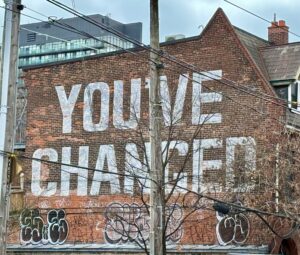
PS: Here’s the poem I mentioned at the start of this letter.
For When People Ask
I want a word that means
okay and not okay,
a word that means
devastated and stunned with joy.
I want the word that says
I feel it all, all at once.
The heart is not like a songbird
singing only one note at a time,
more like a Tuvan throat singer
able to sing both a drone
and simultaneously
two or three harmonics high above it—
a sound, the Tuvans say,
that gives the impression
of wind swirling among rocks.
The heart understands the swirl,
how the churning of opposite feelings
weaves through us like an insistent breeze,
leads us wordlessly deeper into ourselves,
blesses us with paradox
so we might walk more openly
into this world so rife with devastation,
this world so ripe with joy.
Rosemerry Wahtola Trommer
Photo credit: Colette Murphy