Seeking Justice
In a world of multiple considerations, the Atkinson Foundation believes people come first.
Racialized workers who have the lowest incomes are our highest priority. We want to help make the places where they live and work healthier by every measure.
That’s why we support organizations who amplify workers’ voices.
Together, we’re building movements strong enough to change the headlines from stories about the problem of poverty to the solution of decent work. That’s why we take a long view and size up impact over generations as well as work collaboratively. The Long View: Our Strategy to Build Movement Power for Decent Work is our organizational strategy for the period of 2025 to 2035.
Our contribution takes different forms: funding, investing and advocating to protect what matters and create what’s needed for a good life.
Advocacy and public engagement are at the heart of everything we do — from our focus on employment standards and Employment Insurance to care work and community wealth building.

Employment Standards
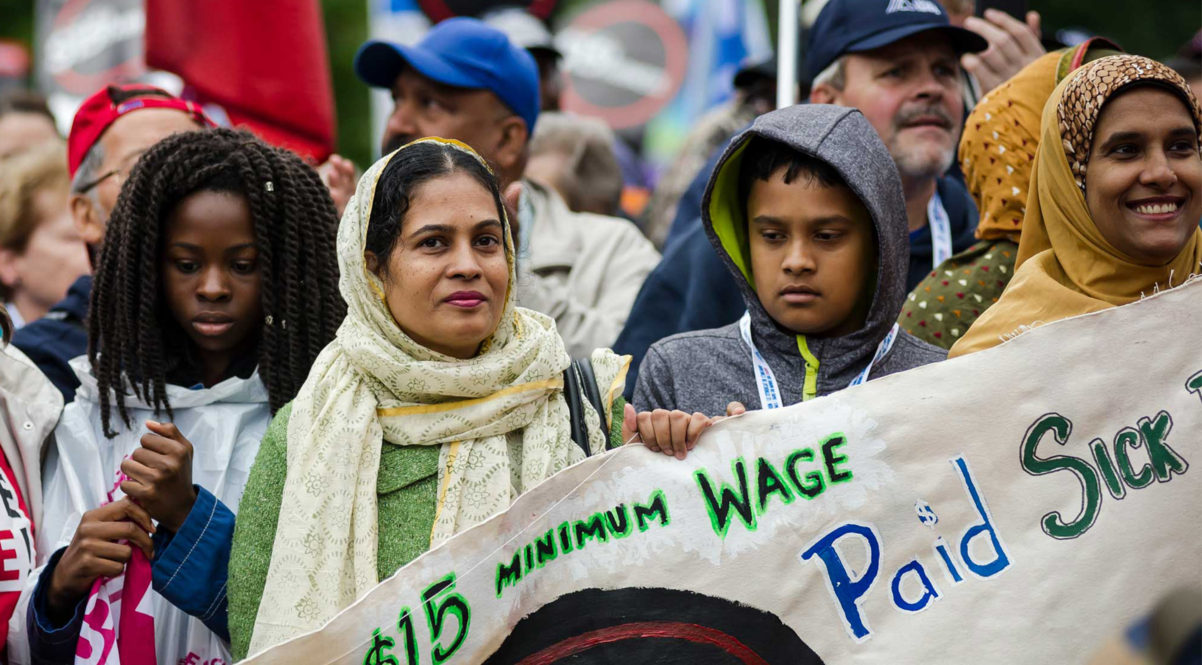
Making decent work real for everyone means guaranteeing a real minimum standard of rights and protections for all workers. It means strengthening and enforcing employment standards, updating laws to include gig and contract work and applying the laws to everyone, and making sure every job is a good job with fair wages, paid sick days, predictable schedules, and workplace safety.
Employment standards and labour relations legislation go hand in hand. By removing barriers to organizing and collective bargaining, and tackling discrimination in hiring and promotion, workers have a say in the decisions that affect their lives and work.

Employment Insurance
Employment Insurance (EI) is a cornerstone of economic security, designed to protect workers through periods of job loss, caregiving, or illness. Over its 80+ year history, it has undergone many changes. In broad strokes, the program initially started modestly, then expanded dramatically in the postwar decades, and later contracted in coverage and generosity.
In recent years, eligibility has tightened, coverage has narrowed, and the federal role in funding has vanished, even as the federal government maintains control over EI policy. Today, fewer than 40% of unemployed workers are receiving benefits, leaving many in precarious or nonstandard jobs without support.
The tripartite governance model of the 1940s has withered: today, workers and employers have little formal input into EI’s administration aside from two representatives on the Canada Employment Insurance Commission, a body otherwise controlled by the federal government. This is despite the fact that employers and employees now pay 100% of the premiums that finance EI.
- Learn more about Employment Insurance reform
- Get briefed on ways to make EI better

Care Work
Care workers make all other work possible. We share a need for care: for ourselves, our families, and communities over our lifetimes. The care economy includes healthcare, education, childcare, and social services. Combined, it currently contributes 13.6% of GDP and 21% of jobs and is growing.
While this sector includes high-paid and secure professions like doctors, nurses, and teachers, much of the labour that sustains the care economy is underpaid, insecure, and undervalued. These include roles like early childhood educators, educational assistants, personal support workers, and home care aides. These roles are disproportionately filled by women, immigrants, and racialized individuals.
Improving job quality across the full spectrum of care roles is critical, not only for worker dignity and equity, but also for delivering stable, high-quality care to people across Canada.

Community Wealth Building
Community wealth building is a transformative approach to community economic development that focuses on democratic control and community stewardship of local assets such as land, labour, and money. It creates the conditions for communities and workers to build shared wealth and for that wealth to remain and circulate in the local economy. The model centres community ownership, racial equity and ecological sustainability as key tenets.
For more than a decade, Atkinson has collaborated with leaders in different sectors to help build community power: leveraging public infrastructure spending and creating real economic opportunities for people who traditionally benefit the least from these kinds of public investments.
- Read a 2026 report by Atkinson and Social Capital Partners.
- Dive deeper into community wealth building.